
Disclaimer: no details will be provided on question content from my exam to honor exam security and protect myself as a student.
If you’re planning on going to PA school, you’ll take the PACKRAT at least once, likely twice. This morning, we took the exam, and I’m here to break down the details for you. (Credit to the PAEA website, which is where all of this information comes from).
What is the PACKRAT and Why is it Administered?
The PACKRAT, or Physician Assistant Clinical Knowledge Rating and Assessment Tool, is a standardized exam designed to evaluate your knowledge at various points during PA school. Given that we just completed our didactic year (the lecture portion of PA school), we took the exam before transitioning into the clinical phase.
The purpose of this exam is to act as a benchmark, helping students and programs assess progress. It is not graded, but rather serves as a tool to see where you stand at the midpoint of your training. The benefit of this model is that, after completing all your clinical rotations, you will take the exam again to see how your experience and studies have paid off. Essentially, it helps to objectively answer the question: “Is the program meeting its goals of preparing me as a student to pass the PANCE and be successful PA?”
How is the PACKRAT Graded?
Unlike a typical exam, you won’t receive a “percent” grade out of 100 on the PACKRAT. You also won’t get feedback on specific questions. However, you will receive a report that breaks down the topics you missed most frequently and those you performed better on.
As the PAEA website states:
“It is recommended that the PACKRAT be used as a self-assessment tool; PAEA does not recommend or intend to recommend a passing grade or interpretation method for the PACKRAT.”
This means that while you won’t know exactly how well you did overall, the report offers valuable insight into your strengths and weaknesses, allowing you to plan for improvement.
More details on scoring and interpretation
Exam Blueprint and Topics
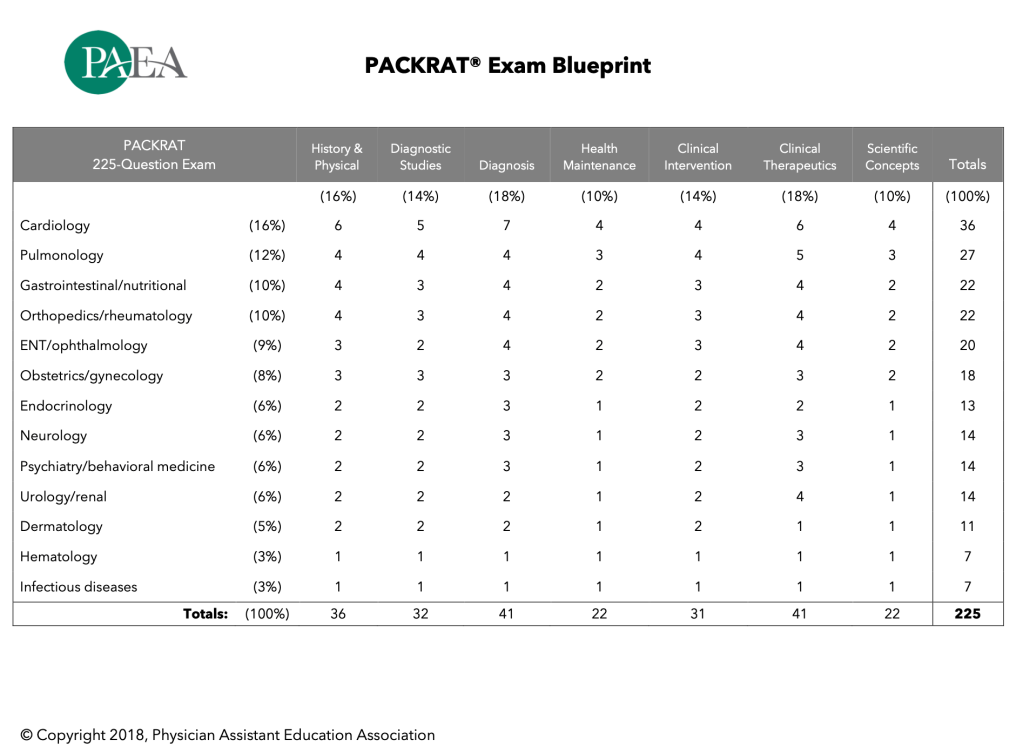
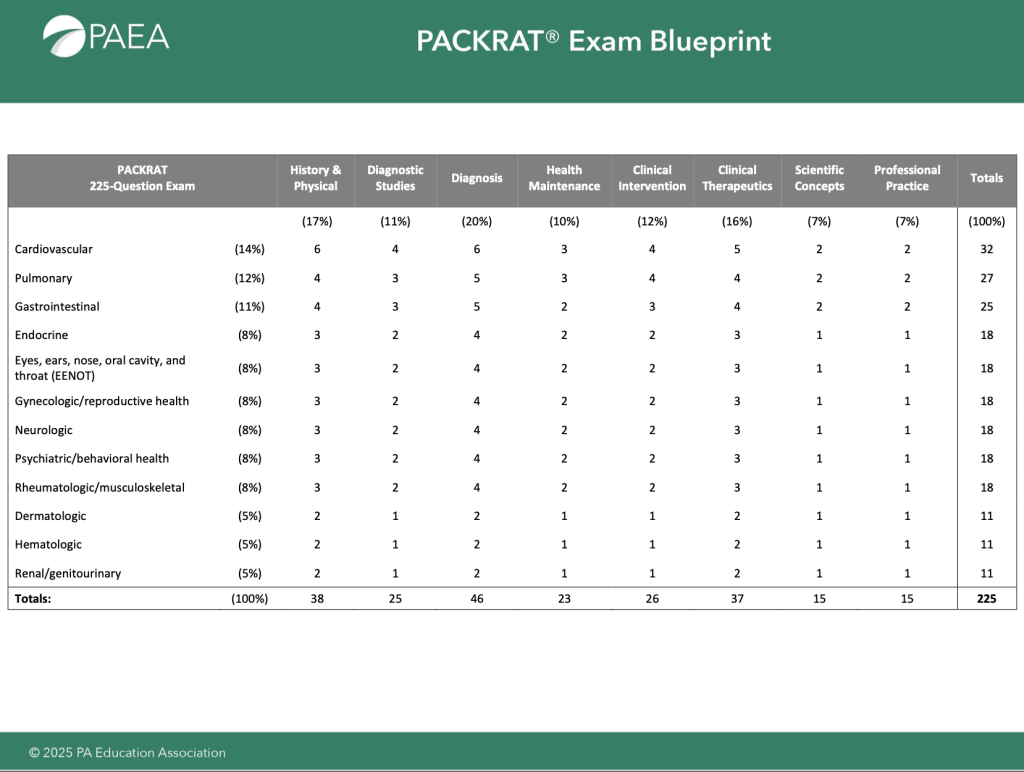
The question breakdown on the PACKRAT mirrors the old PANCE (Physician Assistant National Certifying Exam) blueprint (updated last year). The PACKRAT exam is expected to be updated in November 2025 to fit the new PANCE blueprint, with some adjustments in percentages across categories. The content is divided by system, and the exam will test your knowledge of various topics within each system. In the first image below you will find the blueprint for the current version of the PACKRAT including the number of questions expected in each area. Below it is the new blueprint for the future updated PACKRAT. An example of one change is that the category “Cardiology” was renamed “Cardiovascular” and will decrease from 16% (36 questions) to 14% (32 questions) of the exam.
I highly recommend checking out the topic list on the PAEA website to be aware of the content that may be included on your PACKRAT. Note that this list is not exhaustive, and the PACKRAT exam may cover other topics that are not listed here)
Exam Format
The PACKRAT is a 225-question multiple-choice exam divided into three 75-question sections with 75 minutes allotted per section. You’ll have a 10-minute break between each section, and once you complete a section, you cannot go back to it.
The questions typically come in vignette format, similar to your didactic year exams. The goal is to assess not only your knowledge but also your problem-solving and critical thinking skills. Some questions may ask you to interpret diagnostic studies, data tables, or labs (you’ll be provided with a standard values sheet for the latter).
As you work through the exam, you’ll encounter “two-step” questions where, after identifying the diagnosis, you’ll need to address further management or patient care. These questions can be tricky, so it’s crucial to approach them methodically. I highly recommend reading through the core tasks and objectives because it will give you an accurate idea of what kinds of questions will be asked.
There are two versions of the PACKRAT exam available at any given time, and students are automatically assigned the most recent version they haven’t yet taken.
How Data is Used
Your PACKRAT score report not only provides feedback to you but also to your program directors.
- Student Reports: These reports allow students to see how they compare to other PA students taking the exam across the country. The feedback helps in creating personalized remediation and study plans.
- Program Reports: These detailed reports are designed for program directors to evaluate trends in knowledge across entire classes. This data is used to inform curriculum adjustments and make improvements to the program’s overall effectiveness.
Preparation for the PACKRAT
As for preparation, I didn’t prep for this first PACKRAT because I wanted to have a genuine sense of how much I remembered from last year. This was my first time seeing a mix of topics across various organ systems, as our program is organized by body systems, with exams focusing on a group of systems at a time.
Score report pending, but I feel like it was a strong measure to identify the areas I need to focus on as I move into the clinical phase of PA school.
My Tips for Taking the Exam
- Eat a meal before your exam: Since it’s a long haul, you’ll need energy.
- Stay hydrated: Have plenty of water on hand.
- Don’t stress about the grade: Remember, this is a benchmark assessment, not a final exam. You’ll do great!
- Trust your instincts: If an answer sounds right, pick it and move on. You only have a minute per question.
- Read through all pertinent details in the vignette: Some info is there to distract you. Focus on what’s most important.
- Pay attention to social and family history: If the vignette mentions certain details, example: smoking or a family history of cancer, it’s likely important.
- Don’t spend more than 1 minute per question: Otherwise, you may feel rushed at the end.
- Use the flag question feature: Flag questions you want to review if time allows.
- Process of elimination: If you don’t recognize one of the answer choices, don’t pick it unless you’ve eliminated all other options by process of elimination.
- Revisit the vignette if you narrow it down to two answers: If you’ve used process of elimination and are down to two options, reread the vignette carefully to see if you missed any details that could support one answer more strongly.
- Take your breaks: Get up, walk around, go to the bathroom, or lay your head down and rest your eyes for a few minutes. Don’t power through the entire test without taking your breaks.
- Use your score report constructively: Once you get your score report, use it as constructive feedback to help create a study plan for the PANCE.
Please leave any questions not related to specific test content below!
 Health and Home by Haven
Leave a comment